CloudGoUp

Enterprise operations

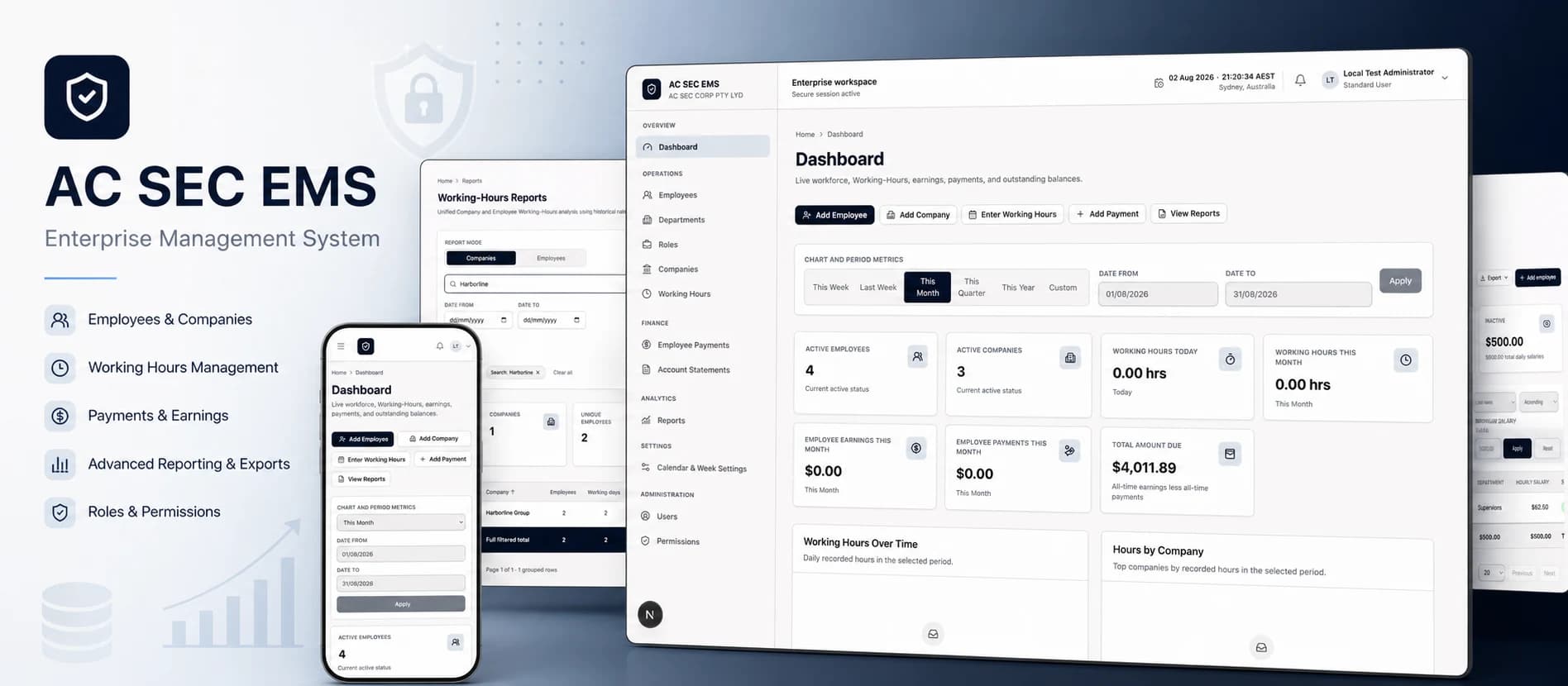
AC SEC Enterprise Management System

A custom enterprise operations platform for AC SEC CORP PTY LYD, built to manage employees, companies, working hours, payments, account statements, reports, exports, and administrative permissions from one secure workspace.

Services involved

Next.jsReactTypeScriptTailwind CSSRechartsLucide IconsNestJSPrisma ORMMariaDB/MySQLJWT AuthenticationArgon2idCSRF ProtectionSecure CookiesRate LimitsAudit LogsCSV/XLSX/PDF ExportsPlesk Node.jsXAMPP/MariaDB
AC SEC Enterprise Management System project preview

Challenge

AC SEC needed more than a public-facing website. The business required a secure internal platform for managing employee records, company assignments, departments, roles, working-hour entries, payments, account statements, reports, exports, and administrative permissions. The system also had to preserve financial accuracy over time, so historical working-hour records could remain stable even when employee salaries, company extra amounts, or master data changed later.

Solution

CloudGoUp designed and developed the full platform end to end using Next.js, React, TypeScript, Tailwind CSS, Recharts, Lucide icons, NestJS, Prisma ORM, MariaDB/MySQL, JWT authentication, rotating refresh-token cookies, Argon2id password hashing, role-based permissions, CSRF header protection, secure cookies, rate limits, audit logs, strict DTO validation, and export workflows for CSV, XLSX, PDF, and print-ready statements. The implementation covered system architecture, database schema, backend API, frontend enterprise UI, authentication and authorization, working-hours and payment logic, reporting, dashboard analytics, deployment preparation, security hardening, and operational documentation.
Outcomes

  • Delivered a secure internal enterprise workspace tailored around AC SEC's real operations
  • Centralized employees, companies, departments, roles, working hours, payments, account statements, reports, exports, and permissions
  • Implemented historical salary snapshots so working-hour financial records preserve salary, company extra amount, hourly rate, and calculated amount at the time of entry
  • Created dashboard analytics, filtered reports, CSV/XLSX/PDF exports, and print-ready account statements
  • Prepared production deployment with Plesk Node.js, a single app.js entrypoint, environment validation, Prisma migrations, and backup/restore scripts

Features planned

  • Secure enterprise workspace
  • Employee records and profiles
  • Company management
  • Department and role assignment
  • Working-hours entry by company and calendar date
  • Historical salary and rate snapshots
  • Employee earnings calculation
  • Employee payment management
  • Live account statements
  • Dashboard analytics
  • Filtered operational reports
  • CSV exports
  • XLSX exports
  • PDF exports
  • Print-ready statements
  • Role-based access control
  • Secure authentication
  • Rotating refresh-token cookies
  • CSRF header protection
  • Strict DTO validation
  • Rate limiting
  • Audit logs
  • Environment validation
  • Backup and restore scripts
  • Production deployment tooling

Implementation approach

CloudGoUp treats each case study as a connected system rather than an isolated interface. The planning work covers user journeys, content structure, technical architecture, measurement, performance, and operational handoff so the project can support future growth instead of becoming difficult to maintain after launch.

The same approach can be adapted for new builds, redesigns, audits, migrations, analytics improvements, and staged roadmaps where the business needs progress without losing control of quality or scope.

User journey

The experience should clarify who uses the system, what they need to do first, and which decisions must feel obvious.

Technical structure

Content, data, integrations, admin workflows, analytics, and performance requirements should be planned before interface polish.

Launch readiness

QA, SEO, accessibility, events, redirects, security basics, and operational ownership reduce risk when the project goes live.

Planning questions

What this kind of project needs before implementation

  • Which user journey needs to be easiest on the first release?
  • What data, integrations, and admin controls are required behind the interface?
  • Which analytics events prove that the product is creating useful business activity?
  • What should be built now, and what should stay in the roadmap until the first version proves value?